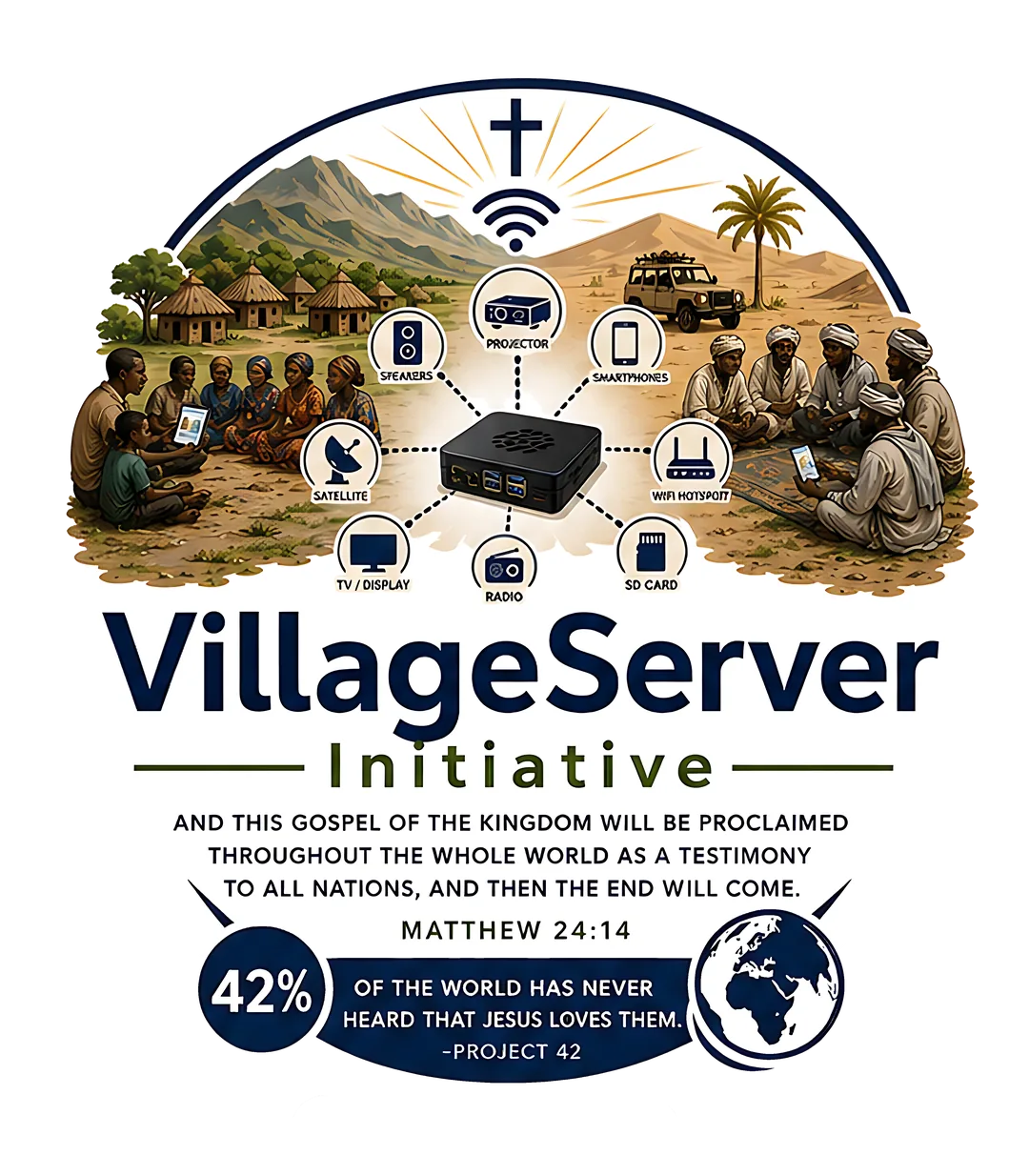
VillageServer is a portable gospel technology initiative. It combines an offline library, local Wi-Fi, phone sharing, battery power, group projection, and optional satellite into one field model that missionaries and local leaders can deploy and teach without technical support.

The complete picture
Most field technology tools try to solve one part of the problem. VillageServer addresses the whole chain: getting content onto a device, making it accessible offline, teaching locals to share it forward, and leaving printed backups when phones aren't enough.
The initiative isn't one product — it's a set of access paths that can be combined based on what the field actually needs. A simple deployment might use only phone sharing and printed guides. A more complex one might include a Raspberry Pi server, solar power, a projector, and a satellite receive-and-replay path for Free-to-Air broadcasts.
How the parts fit together
Every deployment follows the same chain, regardless of kit level:
- Start with the mission context
Understand the language, device types, power reality, and group size before choosing a single piece of equipment.
- Choose the right kit level
Basic phone kit, Raspberry Pi library, power and media kit, or satellite-enabled — matched to the actual field setting.
- Load the library
Scripture, audio, films, children's resources, discipleship materials, and local training files in a clear, browsable structure.
- Set up and train
Unpack, power on, test one file, and teach one local person to run the whole process without help.
- Pilot before scaling
Run the process in one trusted location, record every blocker, and improve before sending more kits.
- Report reach honestly
People trained, devices reached, groups served, and resources shared — simple, honest, verifiable numbers.
What makes this different
- No mobile data required — the library works completely offline at the point of use
- Local leaders can maintain it — the system doesn't require the original builder to be present
- Designed to multiply — one trained person teaches the next; the chain keeps going after the team leaves
- Printed backups — every process has a PDF so the work continues when phones die or servers are packed away
Funding opportunities for Christian missionary organizations
VillageServer Initiative actively supports Christian missionary organizations seeking funding for gospel-access technology deployments. Whether you are planning a first field deployment or scaling an existing program, the following pathways are available:
- Equipment and kit grants — apply for sponsored Raspberry Pi kits, solar power packs, and content library pre-loads through our equipment application program
- Partner organization funding — connect with partner organizations including Digital Bible Society and Kingdom Impact Network, which help qualified Christian ministries access Scripture content, funding, and coordinated technology support
- Campaign-based support — submit a deployment campaign request to receive field-specific guidance and coordinated fundraising support for your mission context
- Donor matching — qualified missionary organizations may be eligible for donor matching through ministry partners when deploying verified VillageServer kits
If you represent a Christian missionary organization placing offline Scripture libraries and gospel media in the field, apply for a VillageServer card or connect with a ministry partner. What we send is the card and its adapter — the phones, servers, projectors, and satellite equipment built around it are obtained locally.
Download the full initiative overview as a printable PDF for board meetings or partner introductions.
Download Initiative Overview PDF